Friday, March 15, 2013

Call Your Dog Off the Beaten Path


Have you ever followed a deer or moose trail winding through field or forest? These trails, very noticeable in snow but less so during other seasons, are used for survival; they provide security. Trails are usually a path of least resistance towards a desired destination such as water, food, shelter, animals of kind, comfort or safe ground. Much of our livestock also make favorite trails or paths. Paths made by sheep, cattle and goats, to name a few, are not usually straight. Flocks and herds like to keep sight of each other and of what is behind them. Curves in the path allow them to do so. Paths are also known ground where animals are confident to move at a faster pace, with less risk to legs and feet.  Protecting limbs is instinctual.

click on pictures to enlarge


Cattle and sheep have made the paths in the snow. Throughout the year, a good eye will see the that paths remain in use.


Herding dogs, unless trained otherwise, are also likely to follow the path of least resistance. For purpose of example, I sent Border Collie, Nibs, to fetch a cow that was on a path heading away from us . I did not give a left or right flank command so Nibs followed the path of least resistance, pushing the cow further away. If I had allowed Nibs to continue, the cow would have sped up. Most likely a race to the head to turn the cow back, using force, would ensue.The opportunity for quiet calm control had passed.


 Next, I called Nibs off. Again, since I had not ask for a flank, she follows the path. Following a path is a common default which can turn into a tenfold training problem in herding.  
Many dogs will resort to using paths, during all seasons, if they are not trained otherwise.


One way to begin teaching your dog to come off a path is to make it fun or enjoyable for them. When your dog is on a path, position yourself parallel to the dog and about thirty feet away. Some dogs will dive right in and come to you while others will search along the path for an easier way. Stop the dog, say “there”, meaning there is the spot where I want you to turn. Call the dog in. Praise the dog.


Once your dog is confident running through uncharted ground, you can direct him off the path to gather livestock. As he is going down a path, stop the dog , say "there", "away to me" or "there", "come bye". Later in training you will be able to drop the stop and "there" commands. Directional commands alone, "come bye" or "away to me", will pull the dog off the path. 


As the dog's training advances, allow him (your choice, not default) to follow livestock down a path. Give him a directional command to go fetch other livestock.


Off the Beaten Path


In this photo, Border Collie, Griz , is pressuring a trio of sheep to go to a pen at the bottom of the small hill.


The sheep took the path or least resistance, away from the dog and down a well worn path to the pen.
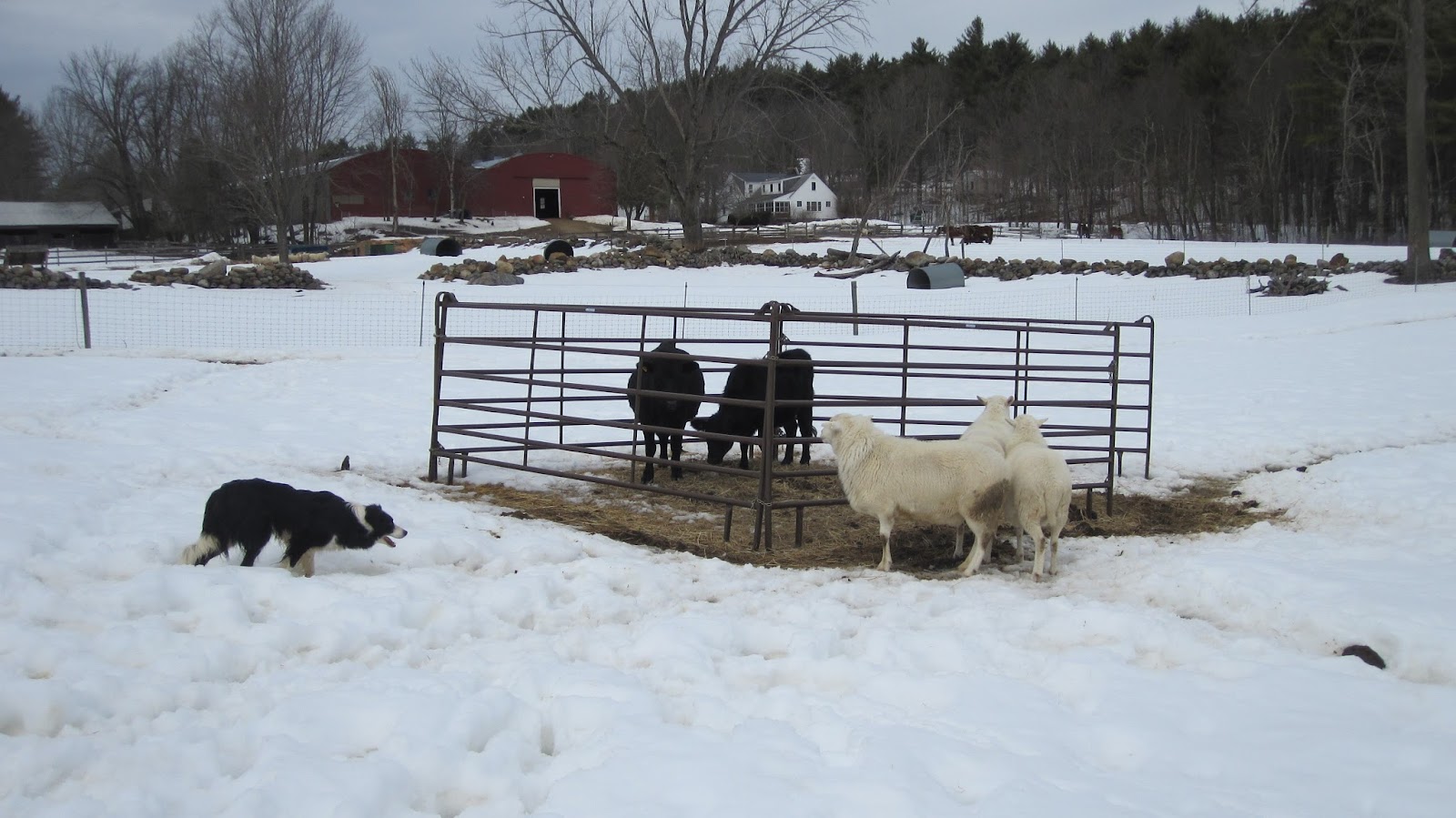


The sheep had followed the path on the right, just behind them. I allowed Griz to follow the sheep until they were committed to go to the pen. I then said "come bye" and "there" to put him in position to push the sheep to the gate. Responding to "there" was critical in not only positioning correctly to influence the sheep; f he had over flanked, he could have pressured the cattle and they would have left the pen.


Once the sheep were at the head of the gate, they were not keen on going into the pen with the cattle. I swung Griz around with "away to me" and then "there" when he was aligned with the sheep and gate. A dog with less experience would have wanted to use the paths. Correct positioning would not have been easy, if at all possible.


With confidence of being comfortable in the environment, Griz guided the sheep into the pen without disturbing the cattle.


I hope this inspired you to have some fun training with your dog in the snow!


Tuesday, February 28, 2012

Raising and Training Stock Dog Pups to become Working Stock Dogs


Introduction

The following is an example of the method I use to introduce pups and start dogs working livestock. It is important to note that both pups do respond to a call off signal, part of the working relationship training that began as soon as the pups could walk. 

The goats are presented to the pups by mentor dogs, under my direction. The pups are not being asked to do anything. The goats are presented in a manner that will bring out instinct and natural ability of the pups. The only words directed to the pups are "ahh", "that will do" and "here". 

~~~

On this snowless February day, Zinc, a black and white male, and Neko, a red and white female, have just turned three months old. Today they will be introduced to livestock with two mentor dogs trained for such responsibility.

RuaBinn, the red and white adult female, has been a great asset to the education of hundreds of pups and dogs. Emma, the black and white female has also contributed to the safety and education of many stock dog trainees.


                                  Please click on the photos for optimal viewing


In the first photo, the pups follow Rua and Em, with interest and excitement, as they drive twenty goats north, across the field.


In the second photo the pups are a little more apprehensive as they realize they are out of the safety zone I have always provided them. Once again, the foundation of the working relationship is seen as the pups defer to me for information and leadership.      
This is a very important observation for handlers to make. It will occur throughout the dog's training. One should be ready to adjust to the pup's needs, as the situation warrants.


A few minutes later, as we approach the end of the first field, the pups are more comfortable in the environment, with the goats, dogs and me. As we move along on this day and for all the days following, my eye will always be on potential. I will make note of character, instinct, strengths, weaknesses, athletic ability, biddability, and how each may change from time to time.


This is a great photo of potential to make note of. Both pups are carrying themselves in a working manner, just as the adults. Although it is too soon to be sure of the type of working dog, if any, the pup may become, it is important to recognize and acknowledge potential when we see it. We as handlers have a choice to nurture or diminish behaviors our dogs present.


As you see here and will see in the following photos, the pups often mirror the behavior of the adult dogs. This too I take great advantage of. In particular, I want the pups to be able to be quiet around the livestock. The by products of constant movement and frenzy is weakness and stress. Through acquiring a calm demeanor, the pups will learn more quickly and gain inner strength and confidence.


This photo shows the pups beginning to flank the herd as we take up the drive again. I like the way the pups are feeling their way around the goats' flight zone.


Here, I have just flanked the dogs around to the far side of the goats to change their direction, now facing the direction the pups were coming from. As the older dogs did this, the pups slowed down and pulled back. I then immediately called Rua and Em in between the pups and goats and told them to hold. The pups are once again mirroring their mentors as they stand and hold.


The dogs and pups were told "that will do", in this case meaning, leave the goats alone and allow them to wander back toward the south end of the field. The pups were then called back to me. A prime time to reinforce a call off is when energy is low.


In this photo I allowed Zinc to accompany Emma, just outside the picture, as she pushed the goats off a short ways.


After calling Zinc off, Neko was allowed to bring the goats back with Rua, in the picture but behind the goats.


A few minutes were given to having the mentors push the goats forward and then backing off to allow the pups to feel the livestock. The pups need the opportunity to learn what reactions their actions will cause.


If you look closely at this picture you will see Neko quickly escaping as RuaBinn dives in to thwart the goats challenge towards the pup. It doesn't take the goats, or any livestock, long to recognize the lack of knowledge, skill or heart of a pup, dog or human. It is important to be able to protect the pup or dog in training.


This is another example of the goats displaying threatening body language and Rua being called in to protect the pups. The pups are being protected but they are also learning what the threatening body language means and how to handle it.


In this very next photo, the pups join in on pushing the goats back. They are gaining knowledge and confidence.


One day Neko may be as big of heart, knowledge and confidence as her grandmother, RuaBinn.


Following another short break, we continued our drive back to the south field.


Once in the field, I slowed everything down again. Notice how the pups are following the slow movement of Em and Rua. The dogs were then told to hold and the pups stopped as well. We took another break. We take lots of breaks. The goats were allowed to wander off. The dogs went for water.


This series of photos is fun. Rua and Neko were still in the irrigation ditch soaking up water. Em and Zinc had returned to me. Zinc's body language indicated he had serious business in mind so I allowed him access to the goats. He went around them nicely and got to the balance point to push them. When he realized he was going to lose them, he flanked around to the front to stop them. Pretty impressive.

Some of the best work you will get from your dogs is from behaviors offered. Too often people get so hung up on obedience that they miss opportunities like this.


We ended this session with Rua and Emma settling the goats on the hill, and "that will do", lie down.
Before long the pups will begin to mirror their mentors and offer the lie down.

I find pups come along so much faster when they are allowed to learn in open fields rather than in a round pen or arena. Many handlers are afraid they will not have control of their pup or dog in an open field, and rightly so. It is the foundation training of the working relationship that makes it possible to train pups in this way.